⚡ Security Status: 33% improvement (50/100 → 83/100).
🏗️ System Architecture Overview
🎯 Core Design Principles
🔄 Reusability
Single authentication service powers multiple frontend applications, eliminating code duplication and
ensuring consistency.
⚡ Performance
Asynchronous email processing ensures users don't wait for email delivery, improving response times.
🛡️ Security
JWT RS256 encryption, bcrypt password hashing, rate limiting, and secure cookie handling.
📈 Scalability
Event-driven architecture with AWS services allows horizontal scaling and reliable message
processing.
Key Innovation: This architecture demonstrates system thinking by implementing a
centralized authentication system with event-driven background processing.
⚙️ Technical Specifications
Technology Stack
Node.js 18+
Express.js
MongoDB
JWT (RS256)
AWS SNS/SQS
AWS Lambda
Docker
Google OAuth 2.0
GitHub Actions
🏛️ Architecture Patterns Implemented
Microservices Architecture
Single-responsibility service handling authentication for multiple client applications with clear
service boundaries.
Event-Driven Design
Asynchronous message processing using AWS SNS/SQS for decoupled email notifications.
Repository Pattern
Clean separation between data access layer and business logic with dedicated service and controller
layers.
Configuration Management
Environment-based configuration with secure secrets management and different settings for dev/prod.
🔧 System Configuration
Authentication Methods:
- Traditional: Email/password with bcrypt hashing (12 salt rounds)
- OAuth: Google OAuth 2.0 integration
Security Implementation:
- JWT Configuration: RS256 asymmetric encryption, 12-hour expiration
- Rate Limiting: 10 requests per 5 minutes for auth endpoints
- Cookie Security: httpOnly, secure, sameSite protection
- CORS: Multi-origin support for production applications
🐳 Deployment Architecture
Containerization:
- Multi-stage Docker builds for optimized image size
- Non-root user execution for security
- Health checks for container monitoring
- Separate development and production configurations
CI/CD Pipeline:
- GitHub Actions for automated testing
- ESLint for code quality assurance
- Multi-version Node.js testing (18.x, 20.x, 22.x)
🌟 Key Features & Design Decisions
Authentication Features
🔑 Dual Authentication
Traditional & OAuth: Supports both email/password and Google OAuth 2.0, providing
flexibility for different user preferences.
🍪 Cookie-Based Sessions
Secure & Persistent: Migrated from localStorage to secure httpOnly cookies, solving
data persistence and security issues.
🎫 JWT Token Management
RS256 Encryption: Asymmetric key signing for enhanced security with 12-hour
expiration time.
🚦 Rate Limiting
DDoS Protection: Configurable request limiting to prevent abuse and ensure service
availability.
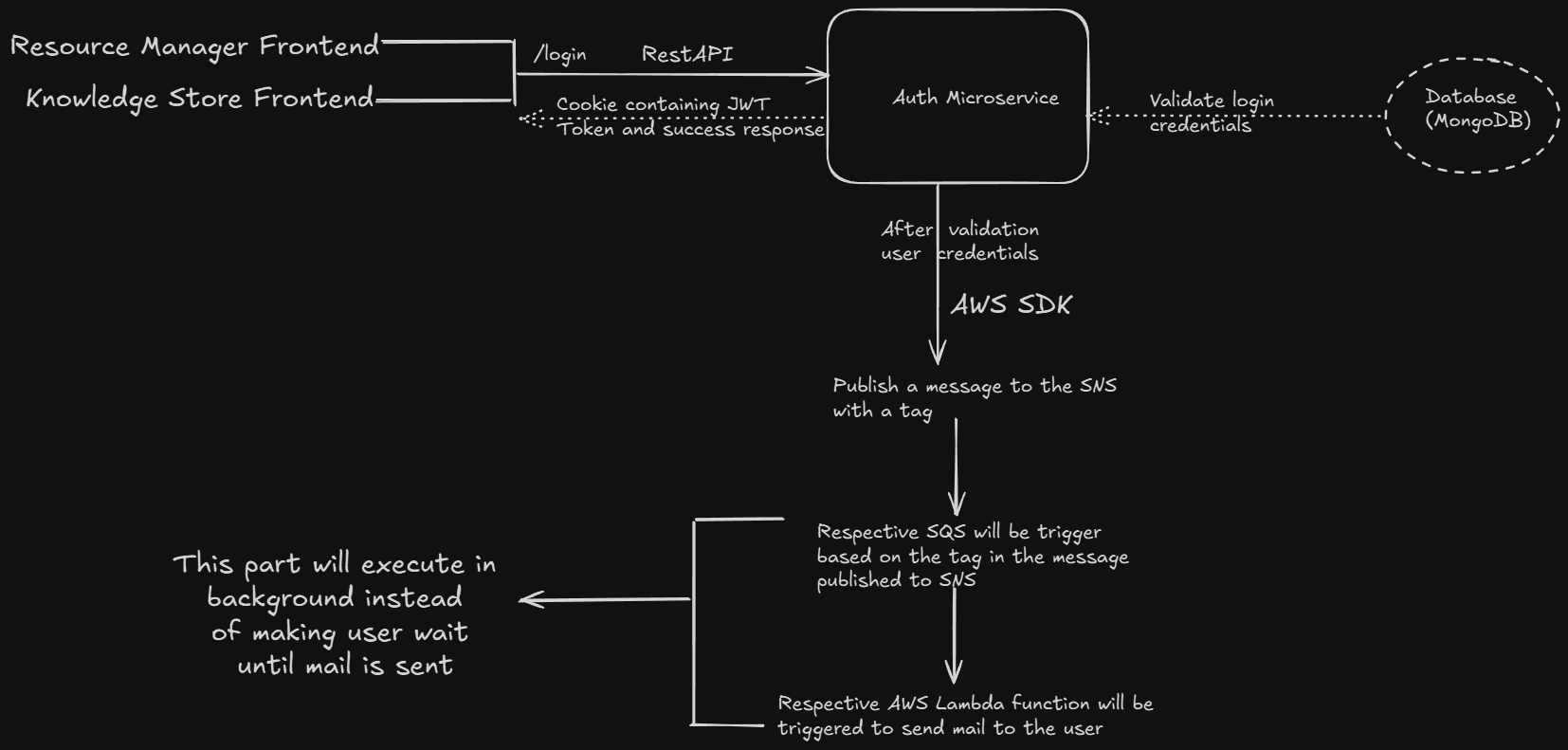
📧 Background Processing Architecture
Design Decision: Implemented asynchronous email processing to prevent user experience
degradation. Users receive immediate authentication response while email notifications are processed in the
background.
Email Processing Flow:
- Event Publication: Auth service publishes user events to AWS SNS topic
- Message Filtering: SQS queues receive filtered messages based on event type
- Lambda Processing: AWS Lambda functions triggered by SQS messages
- Email Delivery: Lambda functions handle email sending
🏗️ Code Organization & Best Practices
Project Structure Design:
- Modular Architecture: Separate folders for users, OAuth, middleware, and utilities
- Configuration Management: Centralized config files for different environments
- Middleware Pattern: Reusable middleware for rate limiting, logging, and validation
- Service Layer: Business logic separated from route handlers
🛡️ Security Design Decisions
Password Security
Bcrypt hashing with salt rounds, secure password validation.
Token Security
RSA-256 asymmetric encryption, proper key management, and 12-hour token expiration.
Request Security
Input validation, CORS protection, rate limiting.
Data Security
Secure cookie configuration, environment variable management, and proper error message handling.
⚠️ Known Limitations
Current System Constraints:
- Token Management: No refresh token strategy implemented yet - users must
re-authenticate after token expiration (12 hours)
- Performance Metrics: Limited performance benchmarks and load testing data available
- Observability: Lacks comprehensive monitoring and
alerting
🗺️ Roadmap & Future Enhancements
⚡ Active Development - Prioritized by Impact & Timeline:
High Priority (January 2025):
- TypeScript Migration: Full type safety across codebase, strict TypeScript configuration with ESNext features, enhanced IDE support and maintainability
- Integration Testing: Jest + Supertest framework, comprehensive test coverage for authentication flows, automated testing in CI/CD pipeline
- Redis Caching: Connection pooling configuration, session storage optimization, cache invalidation strategies for improved performance
Medium Priority (February 2025):
- API Documentation: Swagger/OpenAPI specification, interactive API explorer at /api-docs, request/response examples with authentication flows
- Active Winston Logging: Replace console.log with structured JSON logging throughout application, context-aware logging with request IDs, environment-specific log levels
Future Enhancements:
- Token Lifecycle Management: Refresh token implementation (1-hour access token + 7-day refresh token), token rotation strategy for enhanced security
- Two-Factor Authentication: TOTP-based 2FA with QR code generation for optional enhanced security
System Evolution: This service evolved from localStorage-based session management (with
data persistence issues) to secure cookie-based authentication, solving real-world production problems
encountered in previous projects.
🔌 API Endpoints & Integration Guide
Authentication Endpoints
POST
/api/users/signup
Purpose: Register new user with email/password
Required Fields: name, email, password, username, business
Response: JWT token set as httpOnly cookie + user data
Events: Triggers 'user_registered' SNS message for welcome email
POST
/api/users/login
Purpose: Authenticate existing user
Required Fields: email, password, business
Response: JWT token set as httpOnly cookie + user data
Events: Triggers 'user_loggedIn' SNS message for login notification
POST
/api/users/logout
Purpose: Clear user session and invalidate token
Response: Success confirmation with cookie cleared
OAuth Endpoints
GET
/api/auth/google/callback
Purpose: Google OAuth 2.0 callback handler
Process: Receives Google auth code, exchanges for user data
Response: JWT token set as httpOnly cookie + redirect to frontend
GET
/api/auth/google/verify
Purpose: Verify JWT token validity
Response: Token status and user information
🔗 Integration Examples
Frontend Integration Pattern:
// Login Request Example
fetch('https://yourdomain.com/api/users/login', {
method: 'POST',
credentials: 'include', // Important for cookies
headers: { 'Content-Type': 'application/json' },
body: JSON.stringify({
email: 'user@example.com',
password: 'password123',
business: 'resource-manager'
})
})
🎛️ Configuration Requirements
Frontend CORS Configuration:
- Each client application must be added to CORS origins
- Supports multiple development and production URLs
- Environment-specific configuration management
Cookie Domain Settings:
- Production: Domain-specific cookie settings
- Development: Localhost-compatible configuration
- Cross-subdomain support for multiple applications
Integration Benefits: One-time integration effort provides authentication for unlimited
client applications. Each new frontend requires only CORS configuration update, no code changes needed.
📊 Production Usage & Performance Metrics
Current Production Applications
Purpose: Developer resource management system
Features: Multi-link bookmarks, document uploads, tag-based search, organized collections
Authentication: Email/password and Google OAuth integration
🚀 Deployment & Infrastructure
Current Infrastructure:
- Hosting: VPS deployment with Docker containerization
- Database: MongoDB Atlas for reliability and automatic backups
- Email Processing: AWS (SNS, SQS, Lambda) for scalable asynchronous messaging
- SSL/TLS: Let's Encrypt certificates with automatic renewal
Cost Optimization:
- VPS vs AWS: 70% cost reduction while maintaining performance
- Shared Services: Single auth service reduces infrastructure duplication
- Efficient Resources: Optimized Docker images and resource allocation
💡 Key Learnings & Insights
Evolution Journey: From localStorage session management issues to production-ready
cookie-based authentication with event-driven architecture. Each challenge solved contributed to a more
robust, scalable system.
Technical Insights:
- Microservices Benefits: Code reusability, independent deployment, technology
flexibility
- Async Processing: Significant UX improvement by not blocking user interactions
- Security First: Implementing security from ground up vs retrofitting
- Infrastructure Decisions: Cost vs complexity trade-offs in cloud vs VPS deployment